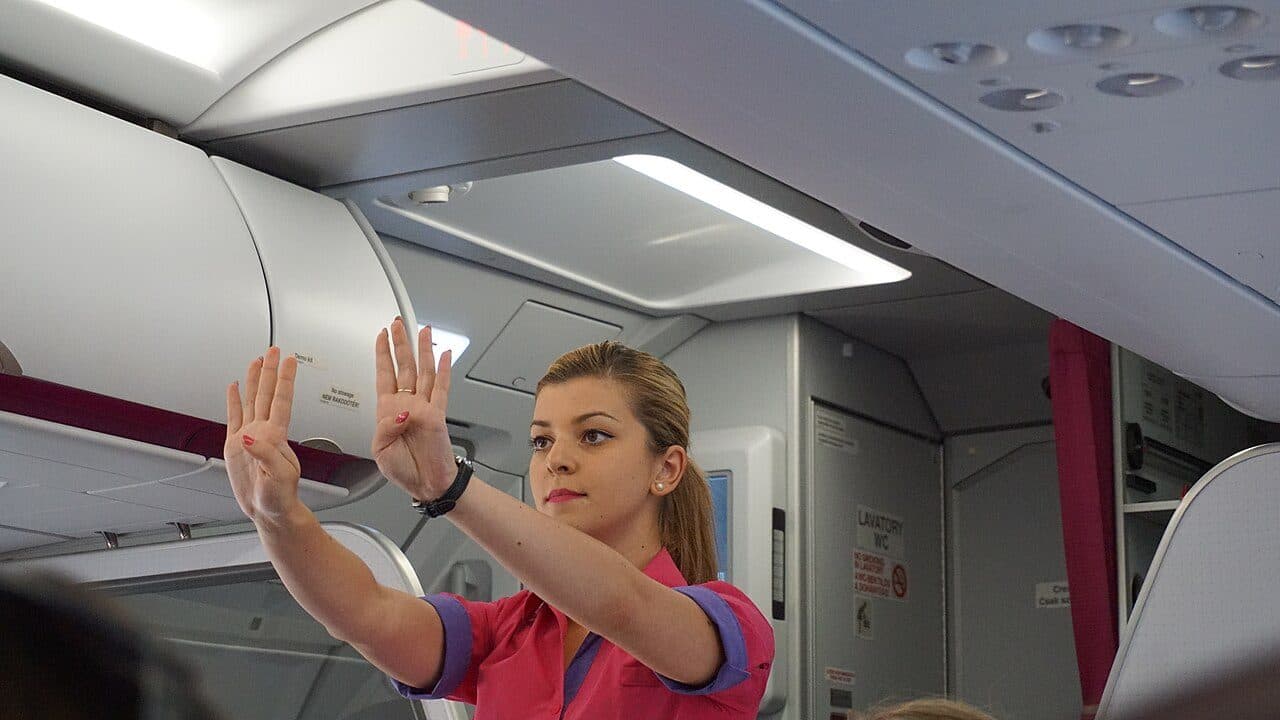
Photo: Miguel Discart · CC BY-SA 2.0 · Wikimedia Commons
CCA revision & exam
CCA Cabin Security: Threats and the Right Reflexes
Published on
Cabin security is often confused with safety, yet it follows a very different logic: it's no longer about managing a technical incident, but a deliberate human intent to cause harm. This topic comes up regularly in CCA exam style questions, and many candidates struggle to tell the different threat categories apart. Here's how to structure your revision for this specific module.
Safety and security: a distinction you must never lose sight of
Safety covers accidental risks: technical failure, fire, decompression, poor weather conditions. Security, on the other hand, concerns deliberate acts directed against the aircraft, its crew or its passengers: intrusion, sabotage, hijacking, attack. This difference shapes the entire response expected from cabin crew, who don't apply the same reflexes to accidental smoke as they would to deliberate threatening behaviour.
The regulatory framework for aviation security rests on international texts such as those from ICAO, supplemented by European rules (EASA) and French rules relayed by the DGAC. The CCA exam doesn't ask you to recite these texts word for word, but to understand the principles they set out: prevention, detection, deterrence and proportionate response. These four pillars come up frequently in exam style questions, phrased in different ways.
Many candidates confuse this module with cabin safety or with general aviation regulations. To avoid this confusion, always ask yourself the following question when facing a practical case: is there an intent to cause harm? If the answer is yes, you're dealing with security, not safety.
The main threat categories you need to know
The syllabus distinguishes several families of threats that you must be able to name without hesitation. Unlawful intrusion into the cabin or flight deck, the presence of a suspicious object, a bomb threat, a disruptive passenger whose behaviour escalates, and the risk of hijacking are all among the typical situations covered. Each calls for a different procedure, even though some basic reflexes remain common to all of them.
The suspicious object is a good illustration of this logic. The CCA exam expects you to recognise the warning signs: an abandoned object, an unusual shape, visible wires, a suspicious smell, or simply something that doesn't fit with its surroundings. The response is never to handle the object yourself, but to immediately alert the commander and follow a precise distancing and containment procedure.
The disruptive passenger deserves particular attention, since behaviour can escalate along a scale, from verbal irritation all the way to physical violence. The module requires you to know at which stage a firmer intervention becomes necessary, and when to formally involve the commander or other crew members as backup. This escalation scale is a classic feature of exam style questions.
Spotting suspicious behaviour without falling back on stereotypes
Behavioural spotting is an exercise in observation, not profiling based on appearance. The CCA exam stresses factual indicators: excessive nervousness, unusual sweating, repeatedly shifting gaze, constantly checking a piece of luggage, insistent questions about security procedures, or behaviour that doesn't fit the context of the flight. None of these signals means anything on its own; it's their accumulation that should raise the alarm.
A common trap in exam style questions is to present a single sign, such as clothing or presumed origin, to see whether the candidate falls into the trap of generalising. The correct answer always rules out this kind of criterion, which has no operational value and can amount to discrimination. Practise spotting these trick phrasings during your free quiz sessions, particularly in the security module available at /qcm-cca.
Vigilance also comes into play before the flight, during boarding. Checking that a passenger's behaviour matches their luggage, noticing hesitation when answering a simple question, or picking up on a sudden change in attitude are all things cabin crew should know how to report without overdramatising, following a clear information chain to the flight deck or the cabin manager.
The response principles expected in the exam
Faced with a confirmed or suspected threat, the CCA exam expects a structured response sequence: observe, assess, alert, then act according to the relevant procedure. This sequence reappears in various forms throughout exam style questions, and the most common mistake is wanting to act before alerting the flight's chain of command. Cabin crew are never the sole decision maker when facing a security threat: they pass on the information and follow instructions.
Communication plays a central role in this response. Using agreed codes, staying factual in the description given to the commander, and avoiding any language that would needlessly alarm passengers are all skills being assessed. This is a frequent point of overlap with the aeronautical communication module, which is worth revising alongside this one so the two subjects aren't artificially separated.
Managing the group of passengers is another important focus. In the event of a confirmed threat, cabin crew must know how to limit panic, guide behaviour without giving explanations that would cause anxiety, and coordinate their actions with the rest of the crew. These general principles apply regardless of the precise nature of the threat, making them a solid foundation to memorise before moving on to specific cases.
How to revise this module without confusing it with the others
The best method is to build a three column table: type of threat, signs to spot, expected response. This format forces you to systematically link a situation to a procedure, rather than learning isolated lists of suspicious behaviours or general instructions. This is exactly the logic you'll find in exam style questions, which always present a concrete case to analyse.
Avoid revising this module in isolation from aviation regulations and aeronautical communication, since exam style questions often blend these three dimensions into a single scenario. A passenger displaying suspicious behaviour during a flight involves security observation, regulated information reporting, and precise communication with the flight deck, all at once.
Once you've built your revision sheets, test them on the free quiz for the security module available at /qcm-cca, then work this module into a full 70 question mock exam at /examen-blanc-cca to check that you can apply these reflexes in a mixed context alongside other subjects. If some nuances still trip you up, ForAllCabinCrew's AI Instructor can rephrase a practical case from several angles until the response logic becomes automatic, rather than something learned by rote.
Related module
- CCA quiz Sécurité / Sûreté314 corrected questions
Keep reading
CCA revision & exam
CCA brace positions: the underlying logic
CCA brace positions: why every movement exists, not just how to reproduce it. The method for understanding and permanently memorizing these
CCA revision & exam
Hypoxia and Decompression for the CCA: Understanding the Basics
Hypoxia, slow or rapid decompression: understand the mechanisms at play so you can answer correctly on multiple-choice questions in the CCA’s aeromedical module.
CCA revision & exam
CCA dangerous goods: the 9 classes
Learn the nine CCA dangerous goods classes with a clear table, designed for the practice exam and for exam day.