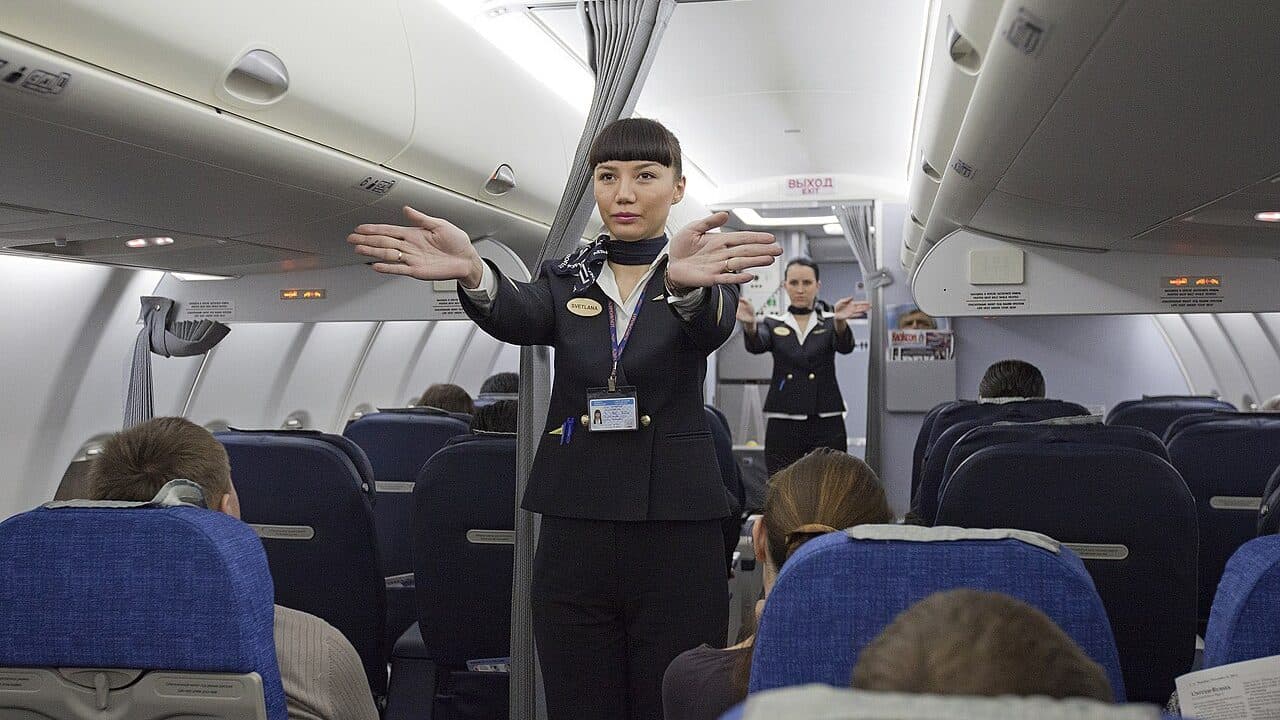
Photo: SuperJet International · CC BY-SA 2.0 · Wikimedia Commons
CCA revision & exam
Revising the CCA fire and smoke module: the method that really makes a difference
Published on
The fire and smoke module is one of the most technical in the CCA (Cabin Crew Attestation), as it combines theory with precise practical actions. Many candidates underestimate it and end up struggling on exam day. Here's how to structure your revision so you can tackle this module with method rather than stress.
Why this module requires a different approach
Unlike more theoretical modules such as regulations or general knowledge, the fire and smoke module relies on a sequence of precise actions carried out in a set order. It's not just a matter of knowledge to recite, it's a matter of building a reflex. Your brain needs to link a situation to a procedure, almost instinctively.
That's why simply reading through the course materials isn't enough. You need to understand the logic behind each step: why you cut off the power supply before tackling the fire, why certain types of fire require a specific extinguishing agent, or why smoke management in the cabin follows a strict sequence. Once you've grasped that logic, memorisation becomes much more natural.
Distinguishing between different types of fire and how to handle them
One point that often causes confusion is the classification of fires and their associated extinguishing agents. It's essential to clearly differentiate an electrical fire, a solid materials fire and a flammable liquid fire, since each requires a different response and sometimes a specific extinguisher on board.
To avoid mixing these up, build yourself a simple summary table with the type of fire, the appropriate extinguisher, and the actions to avoid. This kind of visual aid, which you can review in just a few minutes each day, embeds the information far more effectively than a straight read-through of the course.
Managing smoke in the cabin: a sequence to master
The section on cabin smoke requires particular attention, as it combines several actions that need to be carried out almost simultaneously: locating the source, communicating with the crew, managing passengers and using respiratory protective equipment. The order of priorities needs to be perfectly clear in your mind.
One effective technique is to recite the procedure out loud, as if you were actually living through the situation, rather than reading it silently. This verbalisation engages your memory more deeply and helps you immediately spot the steps you're less sure of.
Common mistakes to avoid when revising
The first classic mistake is learning procedures in isolation, without connecting them to one another. Yet in a real situation, just as in the exam, questions can combine several concepts at once: type of fire, equipment to use and the associated communication. So you need to practise thinking holistically, not just point by point.
The second mistake is neglecting precise technical vocabulary. Confusing two similar terms can be enough to cost you points unnecessarily. Take the time to firmly fix the exact definitions in your mind, especially those that often come up in trick questions.
Similar concepts that lead to confusion
Some questions play on concepts that are related but distinct. CO2 works by displacing oxygen to smother the fire, whereas other extinguishing agents work by inhibition, that is, by blocking the active centres of the chemical reaction. Confusing these two mechanisms costs you time in the exam, as questions often ask for the precise mode of action, not just the name of the agent.
Another example: dry chemical powder is not recommended in the cockpit, due to the risk of reduced visibility and electrical interference. This isn't a blanket ban on the powder, but a restriction linked to the context of the flight deck. This type of nuance is typical of the module's trick questions.
Similarly, the checks to carry out before using an extinguisher (pin in place, seal intact, pressure gauge in the green) shouldn't be mixed up with the checks to carry out after putting on a PBE (protective breathing equipment): seal integrity, correct visibility. Two pieces of equipment, two different check sequences.
The module's sub-topics and their real weight
The fire and smoke module includes 269 questions spread across around fifteen topics. Some are far more heavily represented than others: extinguishing agents, the axe and crowbar, fire classification, and the use of extinguishers are among the topics with the most questions. Other topics, such as causes of fire or automatic extinguishers, are less represented but are still tested.
This distribution gives you a concrete indication of where to focus your efforts first, without ignoring the rarer topics altogether. A realistic revision plan is to start with the sub-topics that have the most questions, then consolidate with the secondary topics once the basics are solid. Working module by module, while tracking your progress on each sub-topic, stops you from revising blind.
Building an effective revision routine for this module
Rather than going over the whole module in one long session, break it down into short blocks and repeat those blocks at regular intervals. This method, based on spaced repetition, is particularly well suited to procedural content like this, where long-term retention is essential.
End each session with a quick self-test, without any notes, putting yourself in the situation. If you get stuck on a step, note it down and come back to it the next day. This gradual approach will let you go into the exam with solid automatic responses rather than knowledge crammed in at the last minute.
Practising on concrete scenarios rather than theory alone
A question such as the one on the minimum number of extinguishers required based on passenger capacity illustrates another type of trap well: regulatory figures that need to be memorised precisely, without mixing them up from one seat bracket to another. This kind of information can't be guessed, it's retained through repetition.
Other questions present a situation to manage, such as working in pairs to access a fire source behind a partition: one person opens up access while the other stays ready to intervene with the extinguisher. This type of question requires understanding coordination, not just an isolated definition. Practising with multiple-choice questions that recreate these scenarios, then checking the explanation given for each answer, helps you embed the reasoning rather than just the answer itself.
If you're stuck on the logic of a procedure rather than a simple memory lapse, discussing it with ForAllCabinCrew's AI instructor can help: it asks questions on the fire and smoke module, responds to your answers and adapts to your level, which usefully complements the standard multiple-choice questions.
Related module
- CCA quiz Incendie & fumée332 corrected questions
Keep reading
CCA revision & exam
Dangerous Goods for the CCA Exam: How to Revise This Module Without the Stress
Classes, labels, passenger baggage, lithium batteries: how to revise the dangerous goods module for the CCA exam and avoid the common pitfalls.
CCA revision & exam
CCA: adapting your method to each module
Every CCA module calls for a different revision method. Find out how to adapt your techniques to memorise effectively and pass the exam.
CCA revision & exam
CCA Mock Exam: How to Prepare Properly and Avoid Mistakes
Find out how to approach the CCA mock exam, the mistakes candidates commonly make, and the right habits to build so you arrive calm and ready on exam day.