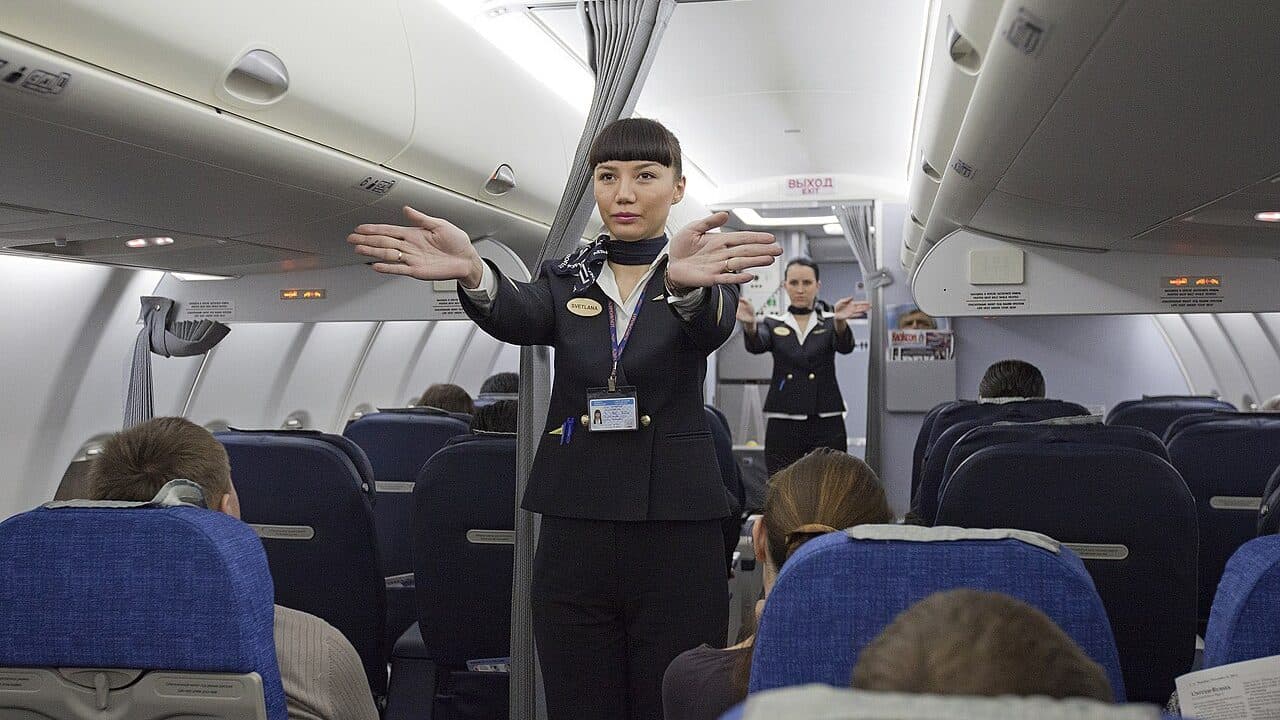
Photo: SuperJet International · CC BY-SA 2.0 · Wikimedia Commons
CCA revision & exam
Revising the CCA’s aeromedical and first aid module
Published on
The aeromedical and first aid module is one of the densest in the CCA, combining first aid techniques, flight-related medical conditions and the use of onboard medical equipment. Many candidates find it intimidating because it mixes medical theory with practical procedures. Here’s how to approach it in a structured way so you don’t feel overwhelmed.
Understanding the logic of the module before memorising
The aeromedical and first aid module isn’t just a list of actions to learn by heart. It answers one central question: how do you respond to a passenger with a health issue in flight, in an environment where you don’t have the same resources as you would on the ground. Before diving into the details, take the time to understand this overall logic, as it will help you connect each concept to a concrete situation.
Mentally split the module into broad families: the effects of altitude and pressure on the human body, basic first aid techniques, the use of onboard medical equipment, and the management of specific medical emergencies such as a cardiac event or an allergic reaction. This structure gives you a guiding thread and stops you from revising isolated pieces of information with no logical connection between them.
What the breakdown of questions reveals
The aeromedical module has 993 questions in the question bank, making it one of the best stocked. This large volume is organised around a handful of well-covered themes: AED, burns, the recovery position, oxygen, and the PARCT assessment. These five themes are among the most represented, which gives you a concrete indication of where to focus your efforts first.
Other themes such as adult CPR, bandaging, tourniquets, airway obstruction and the first aid kit are a little less represented but still well present. Spotting this hierarchy lets you calibrate your revision time: don’t spend as much time on a theme with 11 questions as on one with 30, while still not neglecting the smaller ones.
A multi-step revision method
Start with a full read-through of the course to get an overview, without trying to remember everything the first time around. Then go back through each broad family of concepts and create summary sheets with the key points: symptoms to spot, actions to take, order of priorities. The sheet format is especially well suited to this module because it forces you to separate the essential from the superfluous.
Once your sheets are ready, practise explaining the procedures out loud, as if you were describing the situation to someone else. This technique, often overlooked, reinforces memorisation far more effectively than simply reading back over your notes in silence. It also lets you immediately spot the areas where you’re still hesitant.
End each session with exercises in the form of multiple-choice questions or scenario-based exercises. This trains you to apply the theory rather than just recite it, which is exactly what’s expected of you on exam day.
Concrete examples to anchor the method
Take a question on simple burns: what blister surface area characterises one in an adult? The expected answer is a surface smaller than half the palm of the hand. This type of question tests a precise threshold, not a vague notion. If you only remember “a burn with a small blister”, you risk getting it wrong when faced with a question built around that exact threshold.
Another example, on the recovery position: how is the arm opposite the cabin crew member positioned? The precise answer is that the back of the hand is placed against the cheek on the cabin crew member’s side, palm to palm. This kind of detailed gesture can’t be improvised on the day, it has to be practised over and over, step by step.
Finally, a question on dengue fever asks why aspirin is not recommended. The answer comes down to the risk of bleeding associated with the illness. This type of question combines pathology and pharmacology, two families of knowledge you need to connect rather than learn separately.
Common mistakes to avoid
The first classic mistake is mixing up procedures depending on the type of medical situation. For example, the actions to take when faced with a loss of consciousness are not the same as those for breathing difficulties, and candidates sometimes tend to mix up the priorities for action. Take the time to clearly differentiate each scenario rather than learning one general list of actions.
Another common mistake is neglecting the precise medical vocabulary used in exam questions. Technical terms have an exact meaning, and confusing two similar concepts can cost you points unnecessarily. Read the definitions carefully and make sure you fully understand each term before linking it to a procedure.
Finally, many candidates leave this module for last because it seems less technical than others, such as dangerous goods or fire. Yet it requires just as much rigour and deserves to be worked into your revision schedule early so you have time to properly take it all in.
Training with the right tools, module by module
Once your sheets are built, active repetition makes all the difference. The module-by-module MCQs let you check whether you’re still mixing up two similar procedures, such as chest compressions on an adult versus on an infant. Flashcards are useful for precise thresholds and figures, such as the time limit before serious injury from decompression.
Timed mock exams get you used to answering quickly without losing precision, which matters on a module as dense as this one. If you want to work differently rather than just running through MCQs, ForAllCabinCrew’s AI instructor can quiz you module by module and adapt to what you already know, which helps you pinpoint your areas of hesitation on this particular module.
Also keep the bilingual aeronautical glossary close at hand to check the exact meaning of a medical term whenever a doubt arises, rather than guessing and fixing a misunderstanding in your memory.
Making connections with the other CCA modules
Aeromedical and first aid knowledge isn’t isolated from the rest of the programme. It has direct links to human factors, particularly around stress management and communication in emergency situations, as well as to safety and security on board when it comes to coordinating a response with the crew. Making these connections helps you better understand why certain concepts come up from different angles across modules.
Stepping back to see these links also helps you manage your overall revision time more effectively. Rather than treating each module as an independent block, identify the points of overlap to avoid unnecessary repetition and build your cross-module knowledge more quickly.
Related module
- CCA quiz Aéromédical & secourisme1083 corrected questions
Keep reading
CCA revision & exam
Revising the CCA fire and smoke module: the method that really makes a difference
Find out how to revise the CCA fire and smoke module effectively: key concepts, common mistakes and a lasting memorisation method.
CCA revision & exam
Memory Techniques for CCA Exam Revision
Discover practical memory techniques to help you retain CCA modules more effectively and approach the exam with greater confidence.
CCA revision & exam
Revising for the CCA modules: an effective method
Find out how to organise your revision for each CCA module, avoid common mistakes and approach the mock exam with confidence.