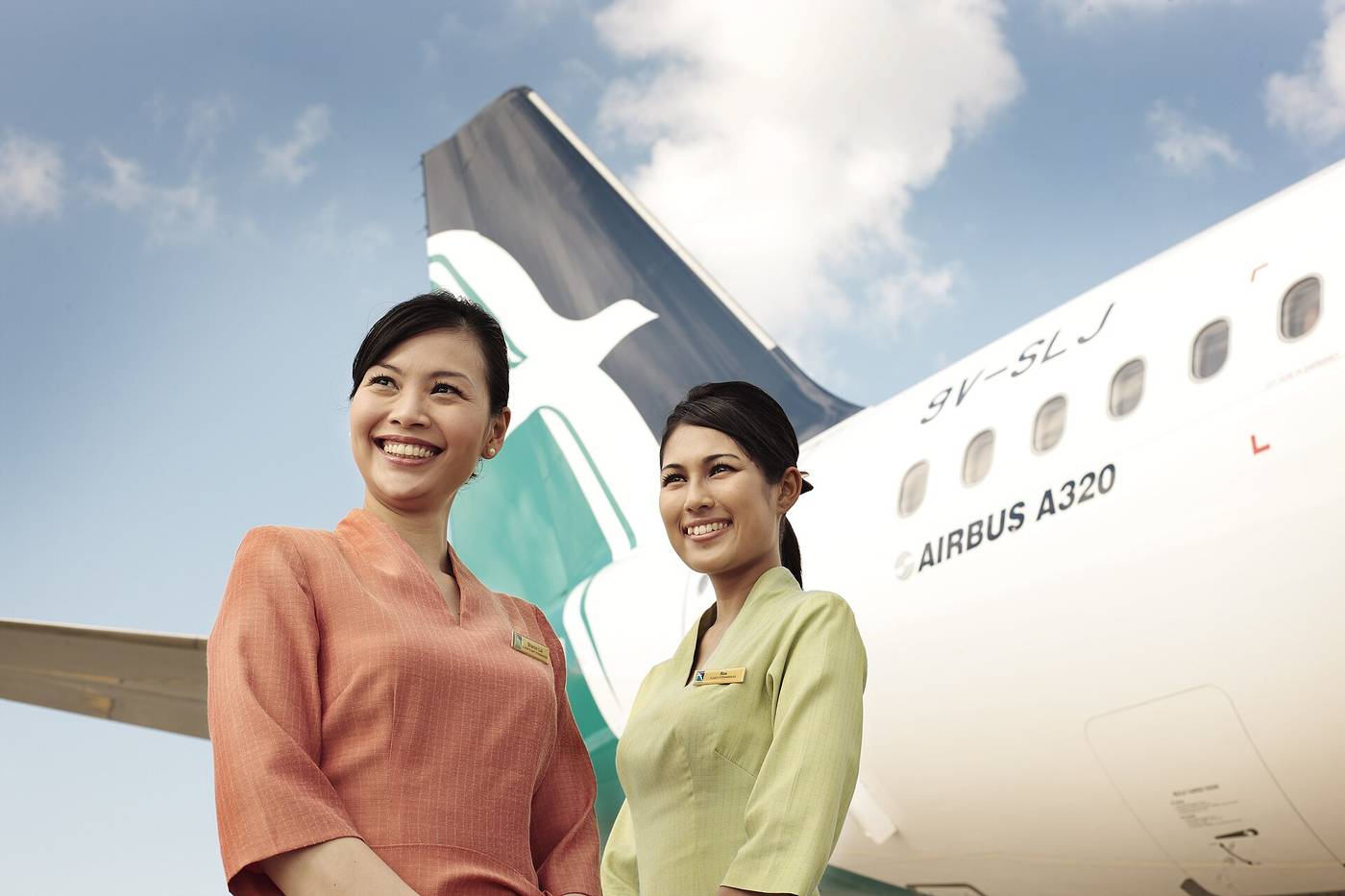
Photo: SilkAir (S) Pte Ltd · CC BY 3.0 · Wikimedia Commons
Cabin crew career
Cabin crew group interview: how to prepare
Published on
Before the individual interview, many airlines put cabin crew candidates through a group interview. This step is often dreaded, yet it follows a clear logic that's worth understanding before you walk in.
Why airlines use this exercise
The group interview lets recruiters observe several candidates at once, in a situation that's closer to real teamwork than a one-on-one interview. On board a flight, cabin crew never work alone: they coordinate with colleagues they may never have met before that day. This exercise artificially recreates that constraint.
Recruiters want to see how each candidate behaves in front of an unfamiliar group, under a bit of time pressure. They watch for who claims their place without overshadowing others, who genuinely listens, who stays quiet out of shyness or strategy, and who tries to dominate the discussion at all costs. These observations often reveal more than a long, carefully prepared speech ever could.
Contrary to popular belief, the goal isn't to identify a leader who hogs the spotlight. Airlines value the ability to move a group forward collectively, not isolated individual performance. A candidate who monopolizes the conversation without making room for others is usually marked down, even if their ideas are sound.
The most common formats
The classic format brings together a small group of candidates around a scenario or a topic to debate, with a limited amount of time to reach a shared conclusion. The topic itself actually matters very little: what counts is how each person interacts with the others during the exercise. Some groups are asked to rank proposals by priority, others to build a collective argument.
Other formats exist too, such as role-plays where each candidate takes on the part of a crew member facing a fictional situation, or building exercises where the group has to complete a concrete task with limited resources. In every case, one or more recruiters observe without stepping in, taking notes on each participant.
The exercise usually lasts between fifteen and forty minutes, depending on the airline. This short format forces candidates to position themselves quickly, without time to overthink a strategy. That's exactly what recruiters are looking for: a natural reaction rather than a fully calculated performance.
The attitudes that make the difference
Active listening remains the single most decisive criterion in this type of exercise. Rephrasing another candidate's idea before responding, drawing out someone who hasn't spoken yet, or simply acknowledging a suggestion instead of bluntly dismissing it: these small gestures show a genuine ability to work as part of a team. They're often noticed more than brilliant ideas that are poorly expressed.
Time management matters a great deal too. A group that reaches no conclusion within the allotted time gives a poor collective impression, even if some members individually did well. Offering to sum up the discussion midway through, or reminding the group of the original goal, are useful reflexes, without taking on the role of a self-appointed leader.
Body language also plays a role, one that candidates focused on their words sometimes underestimate. Looking at whoever is speaking, avoiding closed-off posture, keeping an open stance: these nonverbal signals are observed just as closely as the content of the discussion. A quiet but attentive candidate who steps in at the right moment with a relevant remark is often seen more favorably than one who talks nonstop.
Pitfalls to absolutely avoid
The most common pitfall is trying too hard to stand out by interrupting others or systematically contradicting fellow candidates. Recruiters spot this attitude immediately and associate it with a poor team spirit, regardless of how valid the arguments might be. On the other hand, staying completely silent throughout the exercise out of fear of saying the wrong thing is just as damaging, since it gives recruiters nothing to evaluate.
Another pitfall is treating other participants as competitors to be eliminated rather than potential teammates. Some candidates adopt a competitive stance that completely distorts the spirit of the exercise. Recruiters notice this quickly, especially since several candidates from the same group can be selected at the same time: there's no direct elimination logic between them.
Finally, showing up with a speech entirely prepared in advance, without really listening to the topic at hand, is usually fairly easy to spot. Recruiters prefer sincere, even imperfect, reactions to overly polished contributions that come across as artificial. It's better to focus on a natural, considerate attitude than on a memorized script.
How to practice before the big day
Practicing a group exercise on your own is obviously harder than preparing for a one-on-one interview. One solution is to organize simulations with other CCA (Cabin Crew Attestation) candidates: agree on a topic and a time limit, then discuss afterward how each of you felt during the exercise. This kind of shared feedback helps you spot behavioral habits you might not notice in yourself, like interrupting without realizing it.
It also helps to observe how you naturally behave in meetings or group settings, whether at work or in a club or association. If you tend to hold back, consciously work on speaking up earlier in the discussion. If you tend to talk a lot, practice asking others questions instead of jumping straight to your own ideas.
On the day of the exercise, keep in mind that the goal isn't to win a debate, but to show that you can work well with strangers, in a constrained setting, without losing your composure or your consideration for others. That's exactly what awaits you once you're on the job, with a different crew on every flight.
Ready to apply
Open cabin crew jobs in Europecollected every morning from the airlines
Requirements and selection steps by airline: Air France, Transavia France, easyJet, Ryanair, Wizz Air.
Keep reading
Cabin crew career
The lesser-known duties of cabin crew onboard
Beyond inflight service, cabin crew carry out duties that are often overlooked by the general public. Discover these lesser-known sides of the job.
Cabin crew career
Gulf vs Europe: a comparison for cabin crew
Gulf carriers or European airlines for a cabin crew career: contracts, bases, lifestyle and career progression. A practical comparison to help guide your career choice.
Cabin crew career
Cabin Crew English Level: What You Really Need
What level of English do you need to become cabin crew? Required tests, in-flight use and practical tips to improve before you apply.