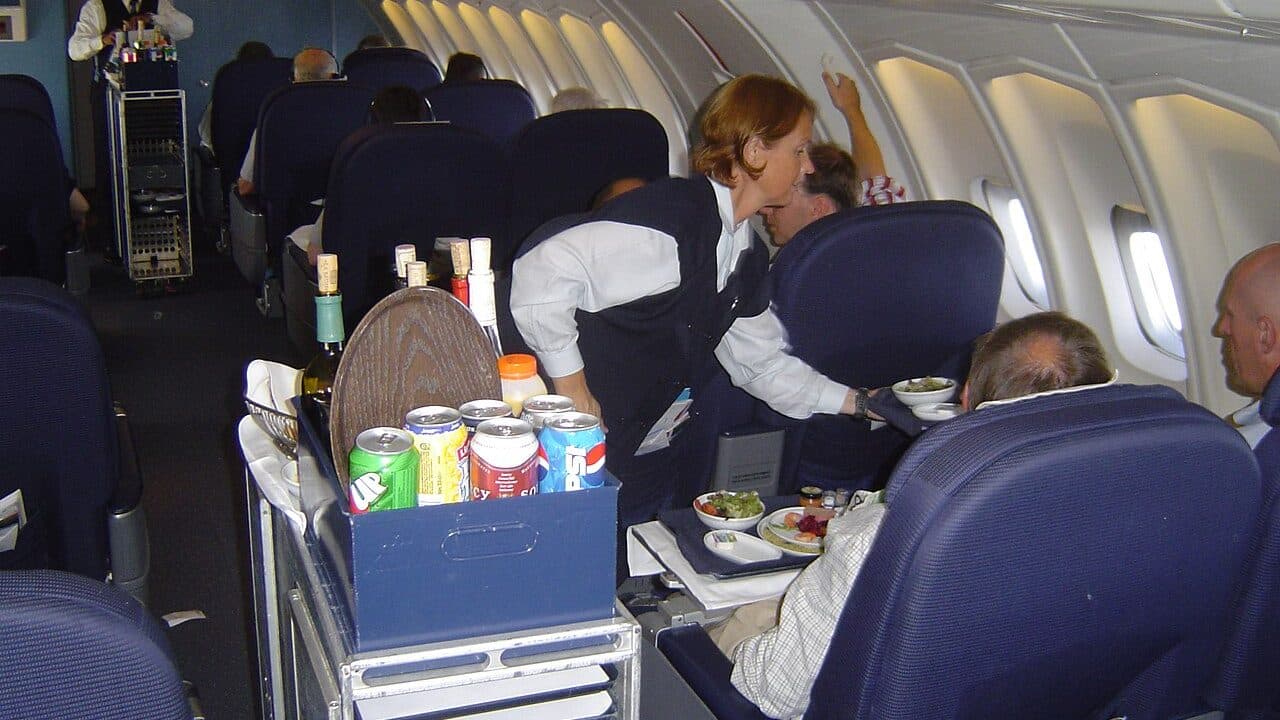
Photo: Saschaporsche · CC BY-SA 3.0 · Wikimedia Commons
Cabin crew career
The lesser-known duties of cabin crew onboard
Published on
When people think of the cabin crew profession, inflight service is usually the first thing that comes to mind. Yet behind the smile and the meal tray lie far less visible duties that make up a significant part of the real work onboard. Here’s an overview of these aspects of the job that candidates often discover too late.
Constant cabin monitoring
Cabin crew are never truly “off duty” during a flight, even once service is finished and passengers seem calm. A large part of the job involves discreetly observing the cabin: spotting an agitated passenger, an unusual smell, a poorly stowed bag or suspicious behaviour. This underlying vigilance is a core part of the security mission, far more so than official announcements might suggest.
This monitoring also extends to passengers’ physical condition. A change in complexion, laboured breathing, or the first signs of discomfort need to be picked up quickly, often before the person concerned even asks for help. This observational skill develops with experience, but it starts right from initial training, particularly through the modules on human factors and aeromedical issues.
Finally, this vigilance also applies to the cabin’s equipment itself. Cabin crew regularly check that exits remain clear, that safety equipment is in place, and that nothing could compromise a potential evacuation. This invisible work never shows under normal circumstances, but it becomes critical in the event of an incident.
Handling unexpected situations
Every flight brings its share of surprises, often minor but sometimes more serious. A passenger refusing to follow an instruction, a conflict between two travellers, sudden turbulence disrupting service: cabin crew must react quickly, without losing their composure or their judgement. Managing the unexpected relies on precise procedures, but also on a good deal of personal composure.
Communication plays a central role in these situations. It takes skill to defuse verbal tension, reassure an anxious passenger, or pass on clear information to the flight deck without giving in to panic. This skill doesn’t come naturally: it’s built up through the simulated scenarios used in training and the experience shared among colleagues.
Some unexpected situations are fairly minor, such as faulty equipment or a last-minute change to the day’s schedule. Others are rarer but far more serious, such as a medical emergency onboard. In every case, cabin crew follow a set procedure while still adapting to the specifics of each situation.
The overlooked role of information relay
Cabin crew hold a unique position: in direct contact with passengers, while staying in constant communication with the flight deck and the rest of the crew. This position makes them a genuine information relay, one that is often underestimated. A delay, a tight connection, a special request from a passenger with reduced mobility: all of this information passes through them before being acted upon.
This role requires a solid grasp of the airline’s internal procedures, as well as the ability to prioritise information. Not everything needs to be reported to the captain straight away, and knowing how to sort what matters is one of the skills that sets an experienced cabin crew member apart from a newcomer. This sense of priority develops over time, through flights and situations encountered along the way.
Cabin crew also act as a link between passengers themselves and ground teams, particularly during connections or extended delays. They pass on information, address concerns, and help make the passenger’s journey smoother beyond just the flight itself.
Equipment maintenance and checks
Before every flight, cabin crew carry out a series of checks that largely go unnoticed by passengers. Fire extinguishers, oxygen masks, medical kits, life vests: every piece of safety equipment must be checked, counted and confirmed compliant before take-off. This step, known as the pre-flight check, sets the tone for the rest of the flight and is the direct responsibility of the crew member carrying it out.
These checks aren’t limited to safety equipment alone. Cabin crew also check the general condition of the cabin, the availability of service equipment, and the compliance of specific equipment depending on the aircraft type. Since every aircraft has its own configuration, this check requires solid technical knowledge, built up through the qualifications gained on different aircraft types.
This checking work continues throughout the flight, in a more discreet way. Cabin crew keep an eye on the condition of the equipment used during service and report any issue as soon as it appears. This rigour, instilled from initial training onward, remains a professional reflex throughout a career, regardless of the number of flight hours accumulated.
A job with far broader responsibilities than it seems
These various duties show that the cabin crew profession goes well beyond the inflight service image so often portrayed. Safety, security, crisis management, communication and technical rigour are constantly intertwined, sometimes within just a few minutes. This versatility explains why recruitment remains demanding and why CCA (Cabin Crew Attestation) training covers such a wide range of modules.
Understanding this reality before starting out in the profession makes it possible to approach CCA preparation from a different angle. Each training module actually corresponds to a concrete duty carried out on a daily basis, which gives real meaning to subjects that can sometimes feel theoretical or abstract during revision.
Keep reading
Cabin crew career
Cabin Crew English Level: What You Really Need
What level of English do you need to become cabin crew? Required tests, in-flight use and practical tips to improve before you apply.
Cabin crew career
Cabin crew group interview: how to prepare
Cabin crew group interview: understand group role-play scenarios, what recruiters expect, and how to stand out without overshadowing others.
Cabin crew career
Senior Cabin Crew Member: Role and Responsibilities
Discover the role of the senior cabin crew member (CCM1): responsibilities, authority on board, relationship with the crew and how to access this position after the CCA.