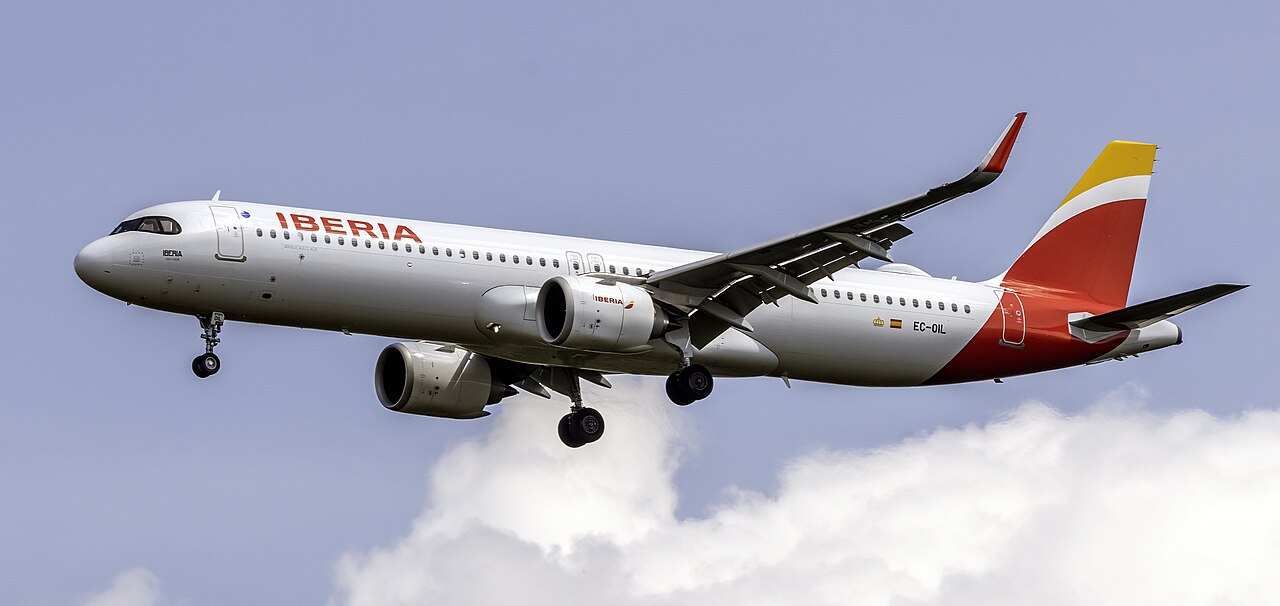
Photo: Acroterion · CC BY-SA 4.0 · Wikimedia Commons
Aviation news
A321XLR MEA: what it means for cabin crew
Published on
On 17 November in Hamburg, Middle East Airlines took delivery of the first of its five Airbus A321XLR aircraft, according to Air Journal and Journal de l'Aviation. This delivery reflects a broader trend in air transport: single-aisle aircraft capable of flying very long distances, with a smaller crew than on a wide-body. Here's what this type of aircraft means in practical terms for a future cabin crew member.
A single-aisle aircraft built for very long range
The A321XLR delivered to Middle East Airlines has 160 seats, including 22 that convert into lie-flat beds in business class, according to Air Journal. This is the first time an aircraft from this family, usually confined to medium-haul routes, has offered a cabin layout so close to that of a traditional long-haul aircraft. The Lebanese carrier plans to receive four more examples, in addition to its upcoming Airbus A330-900s, reports Journal de l'Aviation.
This hybrid configuration meets a specific need: serving routes that are too long for a standard A321 but not busy enough to justify a wide-body. For crew, that means rotations that feel like long-haul in terms of duration, but with a cabin much more compact than on an A330 or A350.
Why this matters directly to CCA candidates
A single-aisle aircraft, even one fitted out for long-haul flying, doesn't have the same cargo hold capacity, the same number of galleys, or the same door layout as a wide-body. That means a smaller crew, more versatility expected between positions, and a potentially heavier individual workload on a flight of ten hours or more. This is exactly where the cabin safety module of the CCA (Cabin Crew Attestation), which covers the location and use of equipment according to aircraft type, really comes into its own.
Business class cabins with lie-flat seats, like the one on this new A321XLR, also call for a different kind of service: seating and settling in passengers, managing privacy in a more confined cabin, and specific emergency procedures for passengers lying flat. A future flight attendant applying to an airline operating this type of aircraft should expect additional targeted training, once they've earned their CCA, on the specifics of this cabin.
The CCA remains the foundation, whatever the aircraft
Whether you're applying to fly on the A321XLR, the A330, or any other aircraft type, the CCA remains the mandatory regulatory foundation before any airline-specific training. It covers the general principles of safety, security and aeromedical knowledge, regardless of the aircraft model you'll go on to operate. The airline then builds on this foundation with an aircraft-type adaptation course, specific to each fleet.
This is a distinction many candidates get confused about when preparing their application: the CCA doesn't specialise you on a particular aircraft, it gives you the common foundations shared by every commercial cabin crew member. The modules on cabin safety and emergency equipment on ForAllCabinCrew are designed precisely to help you understand this general logic, which you can then apply to any fleet.
A market that keeps renewing itself
This delivery is part of a broader fleet renewal trend among several airlines, particularly in the Middle East, as they look to serve more destinations without always relying on wide-body aircraft. For cabin crew candidates, this translates into steady recruitment needs, since every new aircraft delivered means additional crew to train and qualify.
If you're targeting a Gulf or Middle Eastern airline, it's worth keeping an eye on its fleet news before applying: the type of aircraft operated directly affects flight frequency, rotation length and the skills expected of you. On the cabin crew job listings page you'll find recent postings gathered from airlines' careers sites, useful for spotting recruitment drives linked to this kind of fleet renewal.
Preparing without fixating on a single aircraft
It can be tempting to want to know everything about a specific aircraft before you've even earned your CCA. It's better to flip that priority around: focus first on mastering the general principles of safety, first aid and regulations, which will be required of you regardless of the aircraft. The specifics of an A321XLR or an A330 will come later, during airline-specific training, with materials dedicated to each fleet.
The free quizzes by module on ForAllCabinCrew, along with the 70-question mock exam, let you check that you've got these general foundations down before thinking about the particularities of any given fleet. It's this solid grounding in the fundamentals that will let you adapt quickly, once you're hired, to whatever type of aircraft your airline operates.
Keep reading
Aviation news
Emirates recruiting in France: what’s changing
Emirates is holding more and more cabin crew recruitment days in France. Find out how to prepare for them and what this recruitment model really involves
Aviation news
airBaltic to recruit 200 junior cabin crew
airBaltic is launching a campaign to recruit 200 junior cabin crew. Here's what this recruitment drive means for a CCA candidate.
Aviation news
Air Antilles Liquidation: What It Means for Cabin Crew
Air Antilles in compulsory liquidation: what are the consequences for cabin crew, and how can they bounce back to another airline after this bankruptcy.